How to sidestep a tax bomb when selling your home
daniel June 13, 2022
Real Estate

daniel June 13, 2022
Real Estate
With soaring prices and record home equity, you may expect a profit from selling your property. But the windfall may trigger an unexpected tax bill next April.
While home profits dipped slightly, the typical single-family seller still scored a $103,000 gross profit during the first quarter of 2022, according to ATTOM, a nationwide property database.
Although many skirt taxes with profits under the capital gains thresholds, others — especially long-time homeowners — may have a costly surprise, experts say.
Home sales profits are considered capital gains, levied at federal rates of 0%, 15% or 20% in 2022, depending on taxable income.
| Long-term capital gains rate | Taxable income |
|---|---|
| Single filers | |
| 0% | $0 to $41,675 |
| 15% | $41,676 to $459,750 |
| 20% | $459,751 or more |
| Married filing jointly | |
| 0% | $0 to $83,350 |
| 15% | $83,351 to $517,200 |
| 20% | $517,201 or more |
Source: IRS
The IRS offers a write-off for homeowners, allowing single filers to exclude up to $250,000 of profits and married couples filing together can subtract up to $500,000.
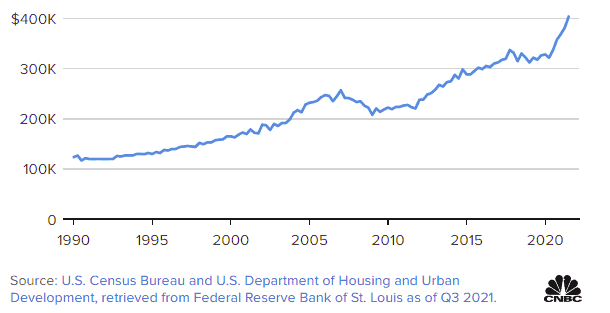
But these thresholds haven’t changed since 1997, and median home sales prices have more than doubled over the past two decades, affecting many long-term homeowners.
“It’s become a huge part of the conversation now,” said John Schultz, a CPA and partner at Genske, Mulder & Company in Ontario, California.
While the exemption may be significant for some homeowners, there are strict guidelines to qualify. Sellers must own and use the home as their primary residence for two of the five years preceding the sale.
“But the two years don’t have to be consecutive,” said Mary Geong, a Piedmont, California-based CPA and enrolled agent at the firm in her name.
The median price for houses sold in the United States over the past 30 years on a quarterly basis. Not seasonally adjusted.
Someone owning two homes may split time between the properties, and if their cumulative time living at one place equals at least two years, they may qualify.
Moreover, someone may convert a rental property to a primary residence for two years for a partial exclusion. In that case, the write-off is based on the percentage of their time spent living there, she explained.
For example, if a single filer owns a rental property for 10 years and lives there for two, they may be eligible for 20% of the $250,000 exclusion or $50,000.
“But you need good recordkeeping,” Geong added.
If homeowners exceed the exemptions and owe taxes, they may reduce profits by adding certain home improvements to the original purchase price, known as basis, Schultz explained.
For example, home additions, patios, landscaping, swimming pools, new systems and more may qualify as improvements, according to the IRS.
However, ongoing repairs and maintenance expenses that don’t add value or prolong the home’s life, such as painting or fixing leaks, won’t count.
Of course, homeowners need to show proof of improvements, which can be difficult after many years. However, if someone lost receipts, there may be other methods.
“Property tax history can help you go back and recalculate some of that,” Schultz pointed out, explaining how reasonable estimates may be acceptable.
Homeowners may also increase basis by adding certain closing costs, such as title, legal or surveying fees, along with title insurance.
There’s also the possibility of other tax consequences when selling a home with a large profit.
For example, boosting adjusted gross income can affect eligibility for health insurance subsidies, and may require someone to pay back premium credits at tax time.
Stay up to date on the latest real estate trends.

September 21, 2026
You own the property—but that doesn't mean every part of the lot is treated the same when it comes to building. Here's what a setback is and where you might encounter … Read more

September 17, 2026
The down payment is only one part of the money involved in purchasing a home. Here are the upfront expenses San Diego buyers may encounter before and around closing.

September 15, 2026
If part of your monthly mortgage payment goes toward property taxes and insurance, that money may be going into an impound account. Here’s what that means and how it w… Read more

September 10, 2026
Condos and detached homes come with different ownership structures, expenses, responsibilities, and features. Here’s what San Diego buyers should understand when compa… Read more

September 8, 2026
We see a home's “year built” everywhere from real estate listings to property records. But what does that little date actually represent?

September 4, 2026
From getting pre-approved to finding the right home and making it through escrow, here’s what can affect the timeline when buying a home in San Diego.
You’ve got questions and we can’t wait to answer them.